
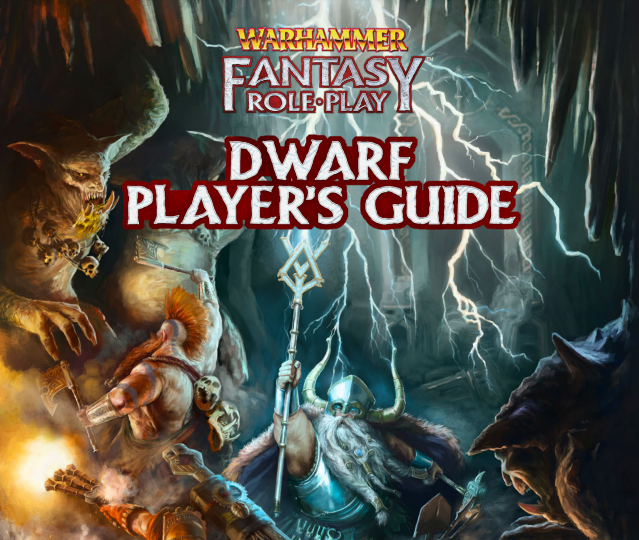
The dwarfs are back in town! A long-awaited supplement for Warhammer Fantasy Roleplay 4th Edition is finally here! This tome is packed with everything you need to know about dwarfs (not dwarves!) in the Old World of Warhammer. Let’s take a look at what’s inside:

While dwarfs are certainly not unique to Warhammer, they’ve made their mark as a *certain* kind of dwarf. The idea of grudges, runes, and slayers make Warhammer dwarfs really stand out from other fantasy settings. Yes, they’re short, stubborn, mine deep in the earth and love ale, but they come with a deep, rich history, and this book does a great job of making dwarfs really their own people.

Who are the Dwarfs? Chapter 1: The Dwarf Kingdoms
Known as the Children of Grungni, the dwarfs of the Warhammer world are a people with an incredibly strong sense of culture. Their traditions are more important to them than breathing, and this has helped keep the dwarf civilization steady and unchanging for millennia. Dwarfs hold a few precious ideals as cornerstones to their culture above everything else: honor, family, and grudges. A dwarf’s word is stronger than the gromril they forge, and to break a promise to a dwarf is an insult of the highest order. Dwarfs make eons-long allies, or the bitterest of enemies. They venerate their elders and ancestors like no other, and perfect their crafts over long lives.

The first chapter of the book, The Dwarf Kingdoms, does an amazing job of describing the connected holds of the dwarfs known as Karaz Ankor. I learned a lot about dwarf history and specific holds in this chapter. The only criticisms I have is my usual one- no maps! I want to know right where Karak Kadrin is, along with the story about it! I know this is something that I complain about with many releases, but I love maps, and when using a sourcebook to create adventures, campaigns, or even NPCs, seeing exactly where in the Old World things are and where people can be from, has a huge impact on the writing. Yes, there are other maps out there, but when Cubicle 7 does include maps, they’re great (Lustria, Sea of Claws, Salzenmund, to name a few)! A map, even of just the Old World, showing the holds listed in Chapter 3, would be a huge boon and makes me sad isn’t included.
What is included is a great, and incredibly complete, history of the dwarfs. RPG sourcebooks are known for giving depth and breathing life into areas of a world like no other publications, and this book does just that. I really appreciate the sidebars on dwarfs that don’t fit the Karaz Ankor mold, like Norse Dwarfs, Imperial Dwarfs, and those that live far from the World’s Edge Mountains.
Chapter 2: Children of Grungi

This chapter, appropriate subtitled “Roleplaying a Dwarf” gives players and GMs so much information to use in game. Whether it’s helping to define the background of a character, or deciding what your dwarf’s favorite food is (there’s even a section on the dwarf diet!), this chapter will help you make your character really feel like a complete person. Reading through this chapter should be mandatory for anyone playing a dwarf PC, and for GMs, just to really understand dwarf culture.

Grudges are a great inclusion for making dwarf characters play differently than non-dwarfs. Instead of choosing personal Ambitions, dwarf PCs carry a personal book of grudges and earn experience when satisfying the grudge. An all-dwarf party can even create Party Grudges instead of Party Ambitions, to guide their actions and earn experience. The rules for this are covered in the next chapter, but here the idea of grudges and how they shape dwarf culture are described in great detail.
Chapter 3: Careers

This chapter is my favorite, as it adds so, so many options for dwarf characters. Like most Cubicle 7 sourcebooks, it makes me want to write an all-dwarf campaign (I’ve already written down some notes for a three-part campaign), and with this chapter that’s very possible with vastly different PCs. Huge tables for dwarf names, places of origin, a glossary for the dwarf language of khazalid, and a new random career table for dwarfs add a lot to the plate of dwarf players. Along with an updated random table, dwarfs get 8 new careers, and new options for existing careers. Do you have a dwarf Engineer or Artillerist? Well, now they can specialize in later tiers as Sky Pilots, Guild Engineers, or Outcast Engineers, whichever best fits your character. Some of these careers replace the human equivalents, like Thane instead of Noble, others are totally new, like the Brewer, Doom Priest, or Runesmith.

You can’t have new dwarf-specific careers without new Skills and Talents! Many of the updated careers, like Soldier or Miner, take advantage of these new options to make dwarf versions of these careers different from their Core Book equivalents. Three new Skills included are Lore (Runes), Runesmithing, and Sail (Skycraft). Each of these gives dwarf PCs more they are able to do, and it’s nice to see something as core to the game as Skills get some new additions.
New Talents are more common than new Skills, but these dwarf-only Talents go another level in specializing your character. Some that stand out to me include: Bludgeoner (better with pummeling weapons), Harpooner (crossbow specialist), Rune Magic and Master Rune Magic (to inscribe runes and make runic items), and Whirlwind of Death (attacking multiple enemies at once with axes chained to your arms!). Again, these new rules give more variety in a potential all-dwarf party. Even Slayers can be different from one another, with paths like Doomseeker, Brother of Grimnir, or a War-Mourner.
Chapter 4: Steel and Fire

Dwarf craftsdwarfship (see what I did there) is known throughout the world as the highest quality. If you want more than just an axe, but a dwarf axe, this is the chapter for you. This chapter is a mix of lore, how dwarfs keep their secrets of smithing close to their chests, as well as rules for all of their creations in game. Some things supersede the same items from other books, like Up in Arms, while others are totally new, like Shield Platforms, Oathstones, and the Anvil of Doom!
Skycraft- like gyrocopters, and watercraft- like Ironclads and Dreadnoughts, round out the chapter with new rules and vehicles to get around the Old World. This section will either see a lot of use, or none at all, depending on the nature of your campaign.

Chapter 5: Runesmithing
This is what most people have been waiting for. Runic items are a staple of dwarfs in Warhammer, and this supplement finally adds them to WFRP! The Runesmith careers were included in the 2nd edition of the game, and they’re back for 4th! Having rules to use and make your own magical items is high on the list of priorities for many players, whether they’re playing dwarfs or not. Who doesn’t want a dope, glowing hammer of destruction?

Like the chapter before, we have a mix of lore and game mechanics for runesmithing. The details presented here for how dwarfs handle learning the craft and passing it on is fascinating, and really showcases the parts of dwarfen personality that make them different from other humanoids.
As for the rules, it’s so nice to have the option officially in the game again. Naturally, creating a runic item is not an easy, or quick, task. A character needs the relevant Skill, Talent, and time to take multiple Endeavors to create these magical items. This is good though, if it were too easy, every party would need to include a runesmith to kit out everyone with magic weapons, armor, and talismans.
Runes can be inscribed on weapons, armor, talismans, war machines, even tankards of ale to enhance the bearer/wearer to super-dwarfen abilities. One of my favorite parts for PCs is the ability to include a Runic Flaw. This gives you a huge bonus (+5 SL) on your Runesmithing test, but then you have to roll on a table. This means your inscription wasn’t perfect, but is able to hold the magic for a time. The item might be destroyed, or even require a Fortune Point to activate!

Chapter 6: Honored Ancestors
The final chapter of the book focuses on belief in dwarf culture, especially their pantheon. Along with typical religious information, like their gods and what they represent, this chapter includes a few cool bonuses like the dwarfen calendar, and how dwarfs venerate their ancestors.
My favorite part of this chapter is the inclusion of lesser-known dwarf gods like Gazul, Smednir, Thungni, and Morgrim. With each god, greater or lesser, basic information is included like: location of their greatest temple, major festivals, common holy symbols, holy sites, strictures, and Cult Runic Magic for their priests.

So Long, and Thanks for all the Rocks

At the end of the day, I can’t recommend this book enough. Whether you have dwarf PCs, want to play as a dwarf, or want inspiration for your adventures, this book has it all. The lack of maps does bring it down a peg, but at this point they’re a bonus in books like these.
So grab a tankard of Bugman’s XXXXXX, strap your axe across your back, and get a-grudging! Until next time, make sure to check out our Patreon at patreon.com/professionalcasual for all kinds of awesome content.

Dan is a founding member of the PCN, GM/host of “A Grim Podcast of Perilous Adventure,” “Settling the Southlands,” “Valley of the Doomed,” and “How Doomed Are We?,” as well as a player in The Lost Omens Podcast, and The Slithering. Dan is also a novelist and writer of adventures.




Leave a Reply