
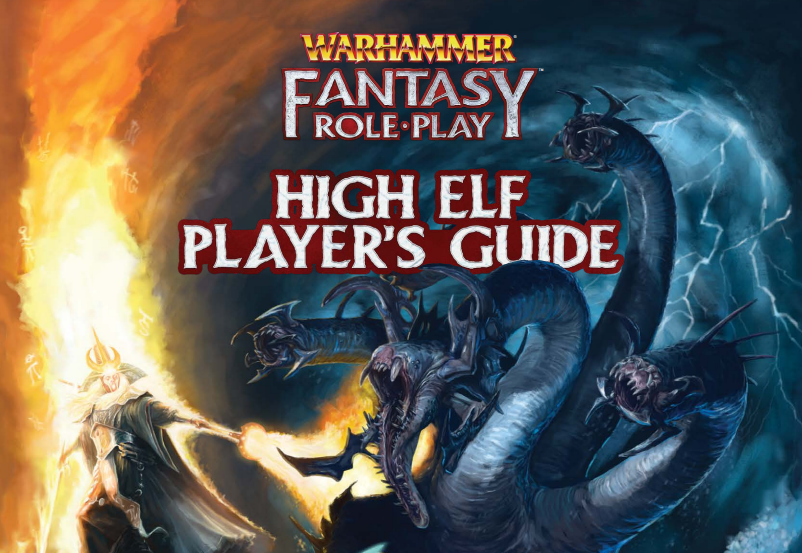
It’s here! High Elves were my second Warhammer army over 20 years ago and I’ve loved the haughty knife-ears since. I’ve been eagerly awaiting this book since its announcement, especially after not getting an elf sourcebook in 2nd edition! When I chose to make a High Elf army for Warhammer: Fantasy Battles, it was mostly because I wanted an army that could do everything- magic, shooting, and combat. This was the correct choice, because elves are good at everything! I get a lot of slack in our community for being a High Elf player due to this sense of superiority, but they just are (for legal reasons that’s a joke)! All kidding aside, I find Warhammer elves more interesting than most settings because they aren’t the Superman-like species, they are deeply flawed, and at the brink of extinction. They are fighting to keep their culture alive in a world that wants them all dead. They’ve made major mistakes, but have also done the world great service through unbelievable sacrifice.

A Brief History of the (High Elf) World
Naturally, the book starts with the history of the Asur. If you’ve read other books about High Elves, there isn’t much new here, except this is the first time I’ve noticed the regular use of the change in name for the Dread King of the Dark Elves- Malerion. People might wonder why he isn’t ‘Malekith’ any more, and the reason is simple: Marvel owns that name. Malekith was created by Walt Simonson in June of 1984 as the king of the Dark Elves. There is no Malekith in Norse mythology, this is a misnomer simply due to the fact that Thor comics were so steeped in Norse mythology (Stan Lee loved it) and people just assumed Malekith was another character taken from the Eddas. So, it’s the usual GW trademark stuff, but in the opposite direction. Marvel owns the name Malekith, so if GW were to keep that name, they would either be in some trouble, or owe Marvel money. Luckily, Malekith already had another name, and now he’s just Malerion.
Either way, I loved this history section. I’m not sure who exactly wrote it, but Dave Allen, Michael Duxbury, Jude Hornborg, Naomi Hunter, Steven Lewis, and Simon Wileman did a great job. It reads as an epic, as it should, but also gives life to the major characters- Aenerion, Malerion, Tyrion, Teclis, and the Everqueens. My favorite part was learning more about Caledor II and how he was just… not good. He started the War of the Beard (Vengeance) and died in the field of battle for no gain.
Side note- I’ve read through the High Elf Arcane Journal for Warhammer: The Old World as well, and I found it very interesting how differently they’re written. The High Elf Player’s Guide is written from a more omniscient point of view, while the Arcane Journal reads more like elf propaganda. Caledor II is painted as a noble warrior who was cut down in his prime by the ruddy dwarfs in the Arcane Journal. I love the different takes that can be shown here in the different media GW produces, and it’s up to us to decide what really happened and how (if) it’ll effect our roleplaying world.

I really appreciate the depiction of elven history from the human perspective as well. There’s a fun four page retelling of the history of the Asur presented to a Lord von Holzkrug. Sadly, the author is not revealed, unless this is something presented in other books and it’s assumed to be the same author and I missed that. Either way, seeing their history from different perspectives in the same tome is enjoyable.


Not only do we get a deep dive into elven culture, but we get a huge honkin’ map of Ulthuan! Granted, it’s the same map as the 8th edition Army Book for Warhammer: Fantasy Battles, but that’s not a complaint, as this is a fantastic map. It even includes a boxed-in map of the Known World, showing where Ulthuan is and it’s scale. Some might be surprised to learn that this ‘island’ is about the same size as the Old World!
The continent is split by a massive range of huge mountains called the Annulii. These mountains are so tall and hazardous, that travel over them is essentially impossible. To travel across them, the High Elves have crafted a series of ‘Gates’ that work as checkpoints and the safest routes through the range. The Inner Kingdoms: Ellyrion, Avelorn, Saphery, Eataine, and Caledor see themselves as even above the elves of the Outer Kingdoms: Nagarythe, Chrace, Cothique, Yvresse, and Tiranoc. Each Kingdom is known for a particular aspect of elven culture that the people there excel at. Such as Caledor, known for their affinity with the dragons, Chrace and its woodsmen and lions, Saphery for the White Tower of Hoeth, and Eataine, where the capitol of Lothern is and they specialize in trade.
As well as High Elven culture, such as how they rear their young and when an elf is considered an adult, this chapter gives depth to descriptions of how the High Elves feel about other peoples of the Known World. Most of these are what one would expect- humans are seen through patronizing eyes, dwarfs are seen as an enemy- but respected, and even the Asrai- the Wood Elves of Athel Loren- are not trusted. I think the most interesting one here is that the Asur respect the humans of Grand Cathay more than other human nations, as they see them as more sophisticated (more like themselves).

This chapter also discusses the High Elves at war, and another map! This one is of the Known World and shows where the Asur have major strongpoints along the southern points of the continents. These were mostly established to slow the incursion of daemons from the southern portal and are all still ‘manned’ by High Elves.
This chapter ends with… rules! Elven weapons, armor, gear, even their ships get stats. Your elven campaign can nearly be run with only elven items from this book! My favorite part here is that all elven weapons have the Durable and Fine Qualities- elves just make things better!

Along with new Careers, High Elf characters come with a few other… partiularities. The first being the concept of Yenlui, a state of balance that all elves struggle with (or let consume them). Elves are naturally pulled to the extremes of the ‘dark side’ of Yenlui, and some feel this pull more strongly than others. The Druchii, or Dark Elves, have given into this side of their psyche completely, and let depravity overtake them.

The next rule unique to elves is Obsessions. High Elves are passionate and emotional, prone to Obsessions. Mechanically, this works like a Long-Term Ambition, but can have negatives as well, forcing elves to potentially act out of character to fulfill their Obsession.
Finally, elves are commonly afflicted with visions as they sleep. Similar to Obsessions, Dreams can take the place of Short-Term Ambitions as the PC has a glimpse of the future and attempts to make it happen (or to stop it).
Like other sourcebooks, the High Elves get specific starting species differences based on the Kingdom they’re from. For example, an elf from Chrace have Outdoor Survival as a Species Skill, while those from Eataine have Charm instead. Even ‘Sea Elves’ have their own Skills and Talents. With new Careers and Talents, a new table is needed as well! Depending on where you hail from, Outer Kingdoms, Nagarythe, Inner Kingdoms, Avelorn, or a Sea Elf, you roll on slightly different Career tables. For example, Nagarythii elves can’t roll many Careers, like Lawyer or Watchman, but they’re the only ones that can roll Shadow Warrior. Many of the Careers from WFRP are slightly amended or come with small roleplaying tips on how this Career would be different for the Asur.
Let’s not forget the new Careers! Sea Guard, Swordmaster, Shadow Warrior, Merchant Adventurer, and Aestheticist (they make things look nice) are all in this chapter. Don’t worry, there are even more later! One of my favorite part of these Careers is a little thematic thing. Instead of the normal symbols from WFRP, High Elves use their own way of classifying their Characteristics at each Tier:


Now we’ve gotten to the thick of things. High Elves love magic. Beginning with some history and lore on how one becomes a mage of Ulthuan, this chapter adds a truckload of new rules, spells, and even runes! My favorite part of this chapter, but it’s just so High Elf, is the list of requirements one must meet before they can take the Talent Blessed by Isha. This Talent then allows the elf to take the High Magic Talent.

Because there are so many requirements, some Careers in this book actually take until a 5th tier to complete!
New Petty and Arcane spells are included, specifically for High Elves. This is in addition to the complete lore of High Magic for the elves. While these spells don’t seem insanely powerful compared to the other Winds, the overcasting bonuses are! One spell as an example, the classic Aphotheosis:

The new Career, Mage, to go along with these new magic rules and spells is simply put: awesome. They gain major spellcasting Talents like Aethyric Attunement and Instinctive Diction early in the track. Their Skills are quite different from Old World Wizards as well. There are virtually no Skills for combat, they focus purely on their spellcasting. These Mages don’t need to hit you with a staff, there’s a spell for that!


Diving into the religious beliefs of a people is often the best way to understand them, and the Asur are no different. The offshoots of the Asur, the Druchii, Asrai, and Eonir, all share the same pantheon, though worship and dogma differ greatly between the cultures.

Reading this chapter, I learned of a few gods I hadn’t heard of before. Nethu, and Eldrazor in particular sound really cool. This chapter is brief compared to others, but is no less packed with lore and rules. A few new, and deep, Careers are here: Smith-Priest of Vaul (more of a Wizard than Priest, they cast spells!), Storm Weaver (newly featured in the High Elf Arcane Journal for Warhammer: The Old World as well), and the Loremaster of Hoeth. Each of these are advanced Careers that aren’t really suitable for starting characters, but more for established characters that have refined their Obsession and passions into their life’s work.
Finally, this chapter gives some space to the Pleasure Cults that eventually lead to the Sundering of the Asur and Druchii. Some of the pantheon above is forbidden in Ulthuan, like Khaine- their god of death and murder.

This chapter is a welcome surprise. Whole campaigns can be built around the Intrigue of the High Elves, and blood doesn’t even have to be spilt (though for an RPG it probably should at some point). My favorite part of this chapter are the box-outs of ‘Whispers of Conspiracy’- plot hooks under a different name. These are fun ideas that can spawn encounters, adventures, or even epic campaigns.
Intrigues typically consist of a few Skill Tests, but these tests will be highly dependent on the information collected about the Target. Do you have some kind of leverage to exploit? Have you figured out the best way to persuade them? Are you prepared for any potential backlash? This chapter is steeped in ideas and mechanics to make this a high-stakes part of your game. These rules aren’t ‘elves only’ either, but can be used with any kind of party.
Venture Forth
The High Elves Player’s Guide is a fantastic book, whether you’re a fan of elves or not. Loaded with lore and gaming options, this book gives an in-depth look at one of the oldest and most storied factions of the Known World. Let me know what kind of character you make or adventure you plan to run with these rules! Use either of the links above to order your copy and get the PDF right away!
Until next time, make sure to check out our Patreon at patreon.com/professionalcasual for all kinds of awesome content.

Dan is a founding member of the PCN, GM/host of “A Grim Podcast of Perilous Adventure,” “Settling the Southlands,” “Valley of the Doomed,” “How Doomed Are We?,” and “Star Omens,” as well as a player in The Lost Omens Podcast, and The Slithering. Dan is also a novelist and writer of adventures.



Leave a Reply