
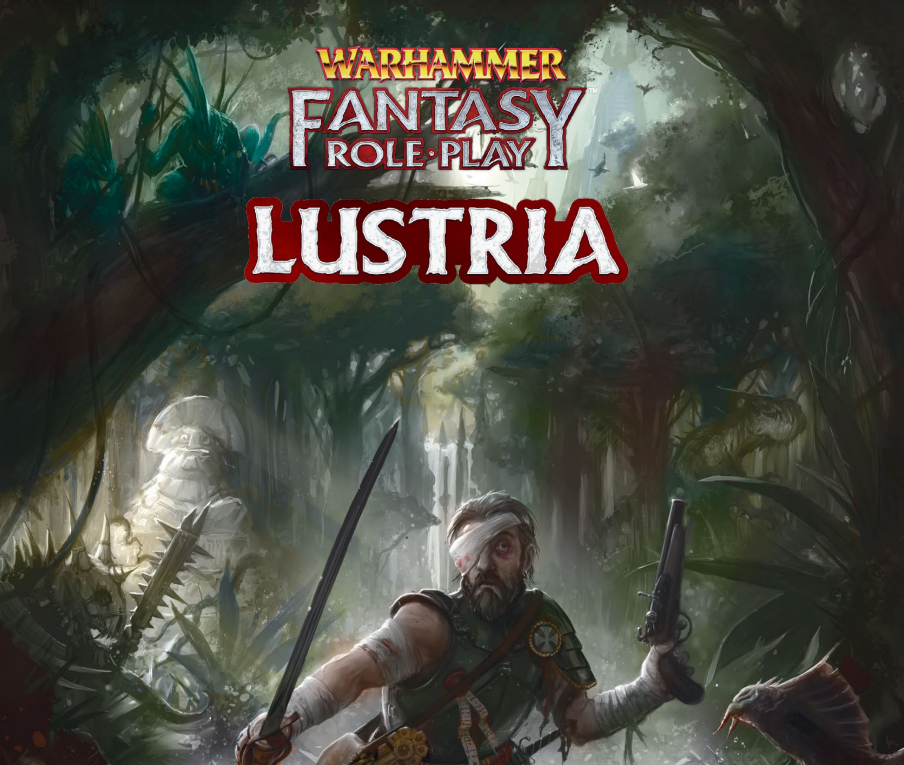

Into the Jungle
Lustria is a long-awaited sourcebook for a fan-favorite region of the world of Warhammer (called Mallus, for trivia buffs). This book is a premier resource for adventuring in the New World, or for use to add some new dangers to your campaign. I wish this book had come out before I wrote Settling the Southlands, it would have saved me a lot of time with diseases and bestiaries! So just what is in this book? A lot. This 224 page tome gives an in-depth view of the continent of Lustria, including the Isthmus of Lustria to the north, just below Naggaroth. Jungle, coastlines, swamps, temple-cities, settlements, bestiary, even campaign ideas an a few short adventure outlines are included in this sourcebook.
While this is meant more for GMs as a way to breathe life into their campaigns, there is plenty of information for Players as well. From the new Careers of Interpreter, Oracle, Survivalist, and Trailblazer, suggested ambitions for PCs and Parties, to new Endeavors.
Places to See, Things to Do

Many places to visit are covered in great detail. There are some awesome maps as well. As always, I’d love more, like the layout the Citadel of Dusk, but the ones they do include are great. There is a map on the inside covers of the whole continent with many locations marked. Some are detailed in the book, others are left to the reader’s imagination. The map of Skeggi is particularly nice, though it’s not to scale and is more of a rough layout (like the city maps of Altdorf and Middenheim). Overall there are dozens of locations to visit and explore and most of them need very little work from the GM to really flesh out.
Skeggi- The Norse Colony in the Jungles:
The last people you’d expect to find in Lustria would probably be the Norse! But on the northeastern coast of the continent you’ll find Skeggi, the oldest and longest-surviving settlement of those from the Old World in Lustria. Skeggi is a brutal place where the Ruinous Powers are worshipped in the open, death is a regular occurrence, and fortunes can be made. I’ve always loved the idea of Skeggi since I learned about it in the old Warhammer Fantasy Battles campaign “Conquest of the New World” (an awesome map-based campaign I tried running multiple times and always fizzled out after a few sessions, I might still have the book!), and the detail given here really brings the settlement to life.

Skeggi is a place where you need to watch your back, but at least it’s safer than the jungle, probably.

Chapter IV details the ruined temple-city of Quetza. A once-powerful city sitting at a nexus of the Geomantic Web of magical energies, the city was abandoned for unknown reasons and then taken over by the Skaven of Clan Pestilens. They were destroyed hundreds of years after Quetza was abandoned by the skink priest Tetto’eko when he led an army to rid the place of the ratmen. He was successful, but only by razing the city himself by calling down a comet with magic to destroy the Horned Rat’s stooges. Sadly, the spawning pools still disgorge Lizardmen following the Old One’s plans, but they are corrupted by the Skaven’s time here and the Saurus that spawn are malformed monstrosities that live short, painful lives. Quetza is a sad place that shows how the depredations of the ruinous powers can destroy the mighty. Included in the chapter are some cool tables for changing the weather with a magic item, NPC stats for powerful characters like Uthl’Kritchnaak the Exalted Herald of Nurgle and the classic Plage Priest Lord Skrolk of Clan Pestilens.

I started reading Lustria in depth not long after completing my review of the Soulbound book, Ulfenkarn: City at the Edge of Death, and the Vampire Coast gives very similar vibes. The vampire Luthor Harkon rules the region with an iron fist. Though there are settlements like New Bechafen where life is cheap, but not everyone is taken into the thrall of Harkon. While he may be mad, Harkon knows to allow some trade to happen within his realm and to allow some travelers through the area, lest no one venture to the Vampire Coast. Luckily for him, his small empire surrounds a major waterway deeper into the continent via the Qurvesa river and his capital, New Bechafen.
Adventuring can still happen here, as Luthor Harkon can be reasoned with, and may even see worth in a party, especially if they’re with a ship and crew. They might be asked to venture further inland, or if that’s their plan already, with Harkon ready to add any who might not make it back alive to his hoard of undead.

Another area that has been on Warhammer world maps forever gets fleshed out quite a lot here. I’m not sure of the Citadel of Dusk has gotten treatment like this in other publications, but this is the most I’ve ever seen about it. It’s inclusion here gives a strong opportunity to run a campaign where the players are elves that live here, possibly part of the Sea Guard, taking on missions inland and out at sea. This chapter even includes Miracles for elven priests of Mathlann, their god of the seas, as well as a new spell for the Lore of Shadows: Shroud of Fog. NPCs, such as Lord Finrian, a noble who owns estates north of the Citadel in the Culchan Plains, and Lokir Felheart, a classic Druchii corsair character and potential campaign villain. There are also new elven equipment like weapons and the hawkship.

The final chapter covering major locations in Lustria is VII: Temple-Cities and Tlaxtlan.

This chapter gives details on many Temple-Cities, some still thriving with the Slann and Lizardmen, others in ruins having been lost to enemies of the Old Ones. This chapter is just packed full of information, to the point where a GM could easily build a campaign around Players as Skinks living in one of these cities. There is an amazing map of Tlaxtlan specifically that gives a great idea of how these Temple-Cities are designed. Unsurprisingly they’re very geometric and logical.

Tons of locations with the cities and adventure hooks fill this dense chapter. GMs can easily set up dangerous places for adventurers to explore, or places for Skink PCs to live. As always, an NPC profile complete the chapter including: Tzku’ta, Chief Attendant to Lord Adohi-Tehga, a Sking priest of reknown.
Servants of the Old Ones

The Slann and their Lizardmen. I love these guys. I recently started a Lizardmen army for Warhammer: The Old World that I’ve been dying to make for decades! I’ve always found the Lizardmen intriguing as a species that is just so different from anything else in the Old World. Cold-blooded, asexual, indifferent, and wholly-dedicated to their gods, the Old Ones. While the name Lizardmen covers quite a few species of creatures, the Slann are something else entirely. They are the direct servants of the Old Ones, and have been trusted to finish their Great Plan since leaving the planet all those thousands of years ago. Not much is known about the Old Ones, except that they came to the Warhammer world and changed it forever. They created many of the sentient peoples that live there now. They even brought the orcs and goblins on accident! For an unknown reason, they left the planet in the same space-faring ships they came on, never to be seen again.
The Lizardmen live to serve the Old Ones, and everything they do is in their name. Skinks are the most autonomous of Lizardmen, having personalities and intelligence at least equal to humans (in many cases they’re quite a bit more intelligent). Saurus and apathetic warriors, spawned for one purpose: war. Kroxigor are large brutes that share an affinity with Skinks and are enduring laborers and fighters. Chameleon Skinks are similar to their cousins, but are created for specific roles in keeping the Temple-Cities safe. The Lizardmen, of course, use many of the native creatures of the jungles to help with their lives and war. Carnosaurs are famous, terrifying mounts for the most powerful Saurus warriors- known as Scar-Veterans and Oldbloods. Stegadons and Bastiliodons have howdahs and arcane contraptions strapped to their huge backs and are used like lumbering war machines and chariots. Many dinosaur-like species are used as mounts as well, from the stupid Cold-Ones, flying Ripperdactyls, and even the cave-dwelling Troglodons. Who doesn’t love dinosaur-people riding dinosaurs?!
Again, this chapter is just stuffed with new options for GMs and Players. New High Magic spells, Skinks as PCs, Marks of the Old Ones for those Skinks, Lizardmen weapons, tons of options to personalize Slann, and more. This chapter has so much information that I can’t cover it too much without rewriting it all. Suffice it to say if you like Lizardmen, you’ll love the deep dive they get here.
1000 Ways to Die in the Jungle

As a GM, the bestiary is often my favorite part of a new book, and this one does not disappoint. New deadly plants, bugs, beasts, and hulking dinosaurs make for one of the coolest parts of this book. As always, I wish there were more images of the creatures, but luckily the chapter starts with a big group shot of most of what you’ll find in the following pages. The majority of creatures here DO have pictures, but I’m greedy and want everything to! After the natives Savage Orcs and new spells for the Savage Waaagh! Lore are included! Again, I wish I had all this when I made Settling the Southlands, it would have saved me from making my own stats for most of these things!
After all the rules for monsters, there are great write-ups about how they act, and even a “Wandering Creature Table” for some random fun. New diseases and symptoms round out the chapter, giving GMs even more ways to make their PCs suffer while exploring Lustria.
Time to Survive

The last few sections of the book are all about gaming in Lustria, with more ideas for GMs, the new Careers mentioned above for players, new Endeavors, examples of plunder to be found, a detailed events table to spice up the exploration, and suggestions of things to do between adventures (like find new PCs). The last chapter of the book gives three short adventure synopses. Again, similar to the ones provided in Ulfenkarn: City at the Edge of Death, these adventures are not complete and ready to go. They are roughly a page and a half of a hook, ideas on where to go, and a dangerous climax featuring the denizens of Lustria. These are great snippets to jumpstart a campaign in Lustria, though I do wish there was something provided with a bit more substance, like a Hell Rides to Hallt-length adventure that could span out into other quests.
There and Back Again

While adventure in Lustria is full of danger and potential treasure, the trip home is the sweetest part of all. Boarding back on ships loaded down with gold, gems, and who knows what else, would be the most relieving feeling ever. After diving into the book, it almost feels like I escaped the continent alive with a wealth of knowledge. Between the amazing artwork, gorgeous maps, and intricately detailed descriptions of the lands of Lustria, I have to highly recommend this book. My gripes are small, and vastly overshadowed by the utility of this tome. If you’re planning an adventure in Lustria, or the jungles of the Southlands, this is a must-own. There are lots of options for gaming tables that aren’t leaving the Old World as well, especially the new PC Careers. Who’s to say some Savage Orcs can’t venture north and find their way into the Empire?
I give Lustria 5-out-of-5 Itxi Grubs.

Dan is a founding member of the PCN and GM/host of “A Grim Podcast of Perilous Adventure,” and “Settling the Southlands” as well as a player in The Lost Omens Podcast, and The Slithering. Dan is also a novelist and writer of adventures.


Leave a Reply